On pricing things like restaurant menus

A couple weeks ago, I learned that Canada will be doing away with the penny.

Well good riddance.  Those things were heavy anyway.

Naturally, a change in currency made me think about the potential impact on prices, and equally naturally, I started thinking about restaurant pricing.  Because, after all, I’m always all about food.  Especially alternatives to instant noodles. :)

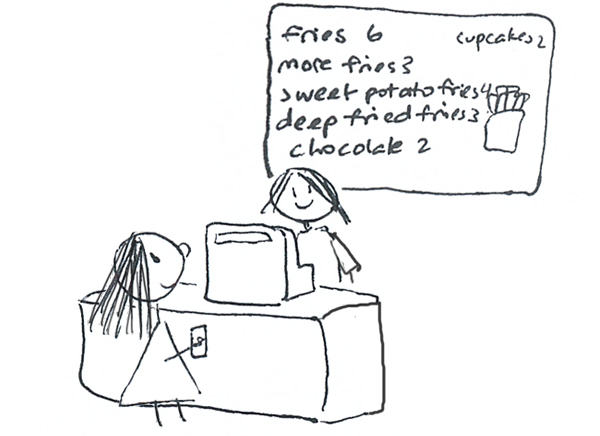
The price at which you set your products can be one of the most important aspects of a marketing mix, and there are things you can do to push certain dishes or cultivate a certain image for your business.

  • Anchoring.  Decisions are often made relatively.  Your most expensively priced dish serves as a mental anchor for the rest of the items.  Typically, patrons order dishes near the top, but not the most expensive dish.  So make sure the item(s) you want to push are priced under the most expensive item.
  • Relative pricing.  Kinda like anchoring.  If you want to push one dish over another, add a dish that is similarly priced but sucks as an offer in comparison.
  • Rounding.  Ever feel like $x.99 anything looks cheap?  Rounding your prices makes the restaurant look upscale.  43% of restaurant managers (and 83% of those who used round prices) felt that customers associated round prices with high quality.  This extends to other industries as well.  One study found that Neiman-Marcus used round pricing of 84% of its items versus 1% for Kmart.
  • Reference prices.  Customers have a general idea about the price range for certain items that make comparing easy.  Examples include soft drinks or hamburgers.  Unless you’ve got some unique spin, price those items within the reference range for your restaurant’s positioning.   Otherwise your restaurant may be perceived as being higher priced based on a few popular common items, even if your prices might be lower overall.  Then again, sometimes creating really expensive hamburgers can work for publicity.
  • Dollar signs.  Don’t.  Interestingly menus without the price caused patrons to outspend parties who got menus with dollar signs.  Perhaps getting away from thinking money makes the spending decision easier?

Just some food for thought.

;)

Posted in Marketing, Positioning | Tagged | Leave a comment

On discounting and shaping consumer behaviour

To me, Banana Republic was a upper-mid range clothing store.  It’s no Alexander McQueen but it wasn’t Ross either.

Then Banana Republic started sending me 40-50% off email coupons.  About weekly.

And now I just can’t conceive of buying Banana Republic products at full price.  It cheapened the brand for me.

Discounting can have a positive effect and short term lift in sales.  It might encourage new consumers to trial your product too.

But discounting done wrong can permanently devalue your brand, because — the moment consumers know to expect discounts, shopping behaviour changes.  (Guilty!)

So what are some important things to keep in mind?

Discount frequently and people will wait for the sale (duh, but what’s “frequent”?)

In one study of soft drinks -

  • If you discount 50% of the time or more (6 out of 12 weeks),  28% of subjects will pay only the sale price.
  • If you offer a deal only 25% of the time (3 out of 12 weeks), 90% of the consumers are willing to pay more than the sale price.

Offering discounts at random to keep people guessing
If you always offer sales in the last day of the month, or around major holidays, people start predicting discounts.  Case in point – I stockpile 12-packs of Coke around major holidays because I know Safeway has the buy two cases get three free around all major holidays and sporting events.

As for the subject of why a single person like me buys that much pop…don’t ask. :)

However, I haven’t yet reverse-engineered REI’s 20% coupon mailing schedule , so when there are holes in my thermal fleece sweater like there is right now, I’ll be buying a full price replacement.

Chose how you frame the discount
Using coupons or rebates for price promotion
 helps maintain the brand image.  Consumers are less likely to have a lower internal reference price.   Options for varying up the price/promotion mix = good. :)

Percentage-off promotions were likely to result in a higher expected post promotion price than cents-off promotions.  So expressing the discount in percentage terms (eg. 34% off $1.49 instead of $0.50 off) is a better strategy to maintain the ability to sell the product at a regular price later.  Keep in mind though, making the value of the percentage discount too easy to calculate (eg. 50% off $100) negates the advantage of using percentages instead of dollars.

If you’re subscription-based, foot-in-the-door discounting isn’t a bad idea.
Comcast does a splendid job on this.  They offered me $29 for high speed internet at an introductory price and then 6 months later – a surprise!  Here’s the $99 per month bill instead.  Consumers are lazy, and some percentage of them won’t notice that change for a while.

Or take FoundersCard’s Charter membership.  A steep discount and perceived value of coming in early to lock in lifetime low price probably got them quite a few signups.  I signed up.

Then there are permanent discount stores.
About 90% of all furniture stores and 99% of rug stores are perpetually going out of business.  But hey, it must work.  They are all still here.

Discounting is a perfectly handy tool, but just realize the expectations you are setting.  Short term attempts to make the budgeted numbers might not be worth it, but it seems like a fine option if used wisely to level out the demand curve or to bring new customers in the door.

Last thought – does anyone think discount sites like Groupon / LivingSocial have totally re-set the expectation of what a deal is?  I now hardly blink at a 50% discount.

Posted in Branding, Marketing, Positioning, Psychology | Tagged , | 1 Comment

My First Guest Post on TechCrunch – Why You’re A Startup Founder: Nature and Nurture

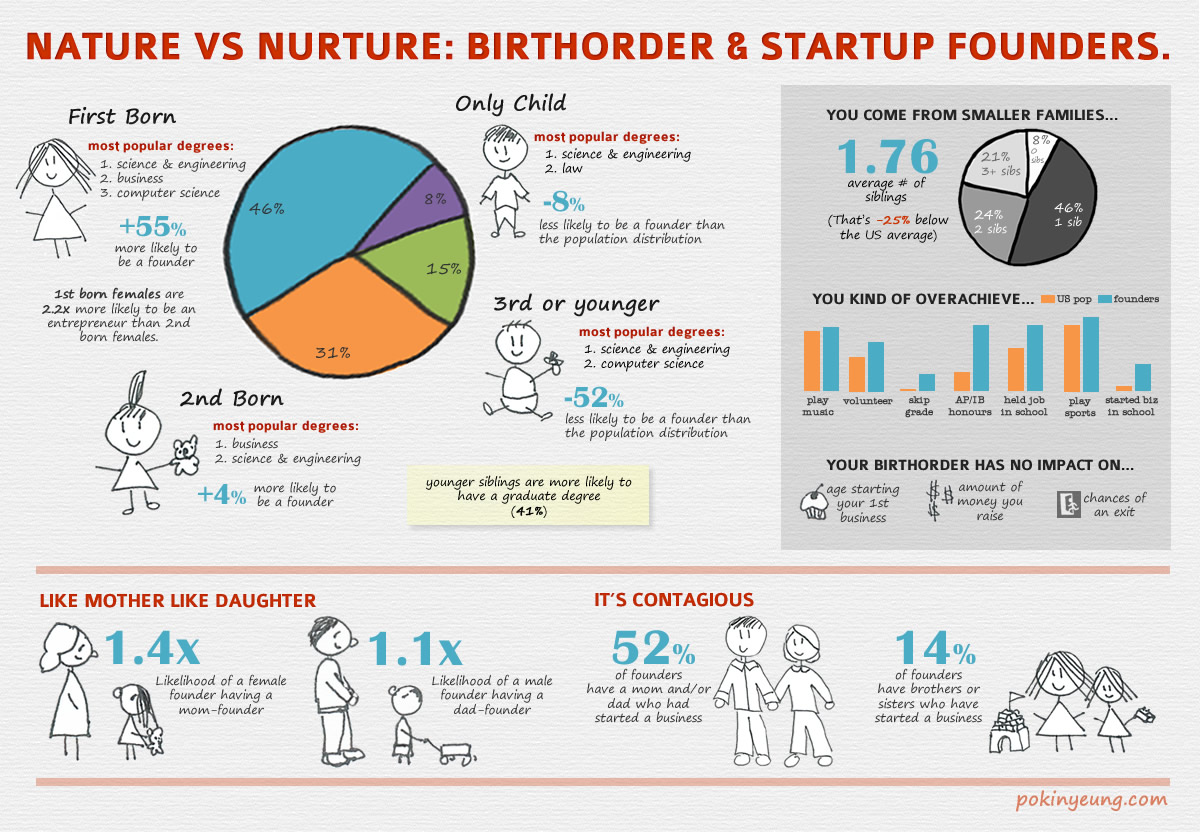
Like most startup founders, I wished for some TechCrunch coverage.   I’m still waiting on that, but I suppose I’ll take guest posting for now. :)   So I’m excited to share my first post– Why You’re A Startup Founder: Nature and Nurture.   In this study, I looked at the effect of birth order on the likelihood of becoming a startup founder, as well as other influences such as having family members that were entrepreneurs.  Thanks to all who participated!

I had to do an infographic too (aka excuse to draw stick figures) so here it is :)   Feel free to share it!

Topline findings:

  • Yes birth order does have an influence.   I compared the birth order distribution of the survey respondents with census information for similar age groups to account for the fact that there are naturally going to be fewer third-borns than second-borns, etc….
  • 46% of startup founders were first-born children (excluding only children) while first-born children (excluding only children) represented approximately 30% of the general population.  The over-indexing of first-born children as startup founders was reinforced by looking at results from two-child families.  Instead of a 50/50 split, first-born children represented 62% of startup founders from two-child families, compared to 38% for second-borns.
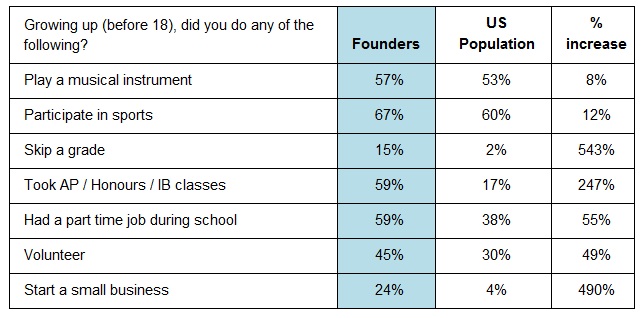
  • Startup founders tend to overachieve and be more active with certain activities than the average person.  Here’s a chart comparing some of the results for survey founders versus the general population:

Achievements and Activities for Startup Founders

Thanks again, all of you who participated in the first survey!   I’m looking into the types of adversity faced by startup founders while growing up next, so if anyone is interested who didn’t participate in my study before, I’d love to ask you some questions here.

Posted in General | 3 Comments

On reshaping existing beliefs and behaviours

A few days ago, I talked about a fellow who wanted to change and stay out of jail.

But changing beliefs and behaviours is difficult.  Hey, people can be stubborn!

So how do you go about doing it?

Go where people don’t know much about you already.
Changing (or establishing) perceptions of a brand or product is easier when general awareness is low and/or consumers have not yet formed a strong opinion about you.   So an opportunity to do this might be when you enter a brand new market.  For instance, fast-food restaurants like KFC and McDonald’s are thought of as serving healthy food in China.  Unencumbered by years of negative perception about their healthiness, they are able to position themselves as higher quality and healthier alternatives to some of the local fare.  To achieve similar perceptions in North America would be near impossible though due to the near total awareness (and association with unhealthy food) people have of these brands.  Supersize Me, anyone?

Catch consumers when they themselves are in a state of flux
So how can you change behaviours when they are already established?  Catch consumers when they are in a period of significant personal change.  Things like getting married, having a baby, getting divorced, moving out of school are all good times to try to change consumer behaviour.

This New York Times article explains how marketers identified the birth of a child as one of those life changing moments that also may lead you to shop at new stores (aside from baby related stores) and purchase different brands than you would have before.

Stress or overload consumers
Similarly, researchers have found that inducing metacognitive difficulties could in some cases result in increased acceptance of marketing claims and thus a more positive brand evaluation.  An example they used involved time pressure (people waiting behind you in line) and something that differed from the usual branding (redesigned packaging), resulting in increased openness to new information.

Bottom line – change in one area induces a greater acceptance of change in other areas.

So think about how you can piggyback on existing change!

Posted in Marketing, Psychology | Leave a comment

On why we feel like there are so many coincidences

This past Wednesday, I met a homeless fellow who’d just gotten out of jail and wants to stay out.

The next morning, there it was.  A front page New York Times article talking about a program that’s reduced ex-inmate recidivism rates by 16-22% compared to the norm.

Ooh, funny coincidence!  Right?

Maybe not so.

It’s more likely the case of selective perception.  Selective perception is a cognitive bias where we filter out and only choose to see the things we’re interested in.  It’s drawn from our preferences and past experiences.  This makes sense, because if we didn’t have any filters, we’d be totally overloaded with external stimuli.

Think of horoscopes. Chances are, when you read them, they seem like they are describing you, right?  Mine does!  I bet if I was to take another sign and show it to you again, you’d find facts that describe you too. :)

So how can you use selective bias to your advantage?

For starters, be aware of that you’re probably going to be preaching to the choir.  Studies have shown that people who already buy a particular brand are more likely than non-purchasers to notice and have a positive reaction to advertising for that brand.  This is important to note when doing market research too.  The Rosser Reeves Fallacy shows that, when evaluating the effectiveness of an advertising campaign, it was actually that purchasers of a brand were more aware of the ads, rather than awareness of the ads causing people to be more likely to buy that brand.

Messages that fit with what a person already “knows” about a brand / product can be very effective.  Their beliefs amplify the effect of your message so that it has a stronger effect.   Of course, you need to make sure that you have done your research into what people really think about your products, since your assumptions of what their views are may be off base.

It generally isn’t a good idea to work against people’s ingrained biases unless  it’s deemed necessary to try to reposition a product or brand.   One analogy would be attempting to swim against a very strong current.   You’ll need to put in extra effort, and changes in their opinions may take a very very long time.   The further your message is from their existing beliefs, the more likely it is to cause cognitive dissonance, which will likely be resolved by dismissing your message.

Still interested in how to change existing beliefs and behaviour?  I’m separately working on posts on how to change behaviour, and what it takes for lasting change.  Since those will take longer, this one first. :)


Posted in Evolutionary psychology, Experiences, Psychology | Tagged , , , | 2 Comments

On procrastination

I’ve been procrastinating.

This of course explains why my posting frequency has been so light.  I told myself I wasn’t posting till I finished something else first, the end result being neither thing got done for well — kind of a long time.

But I don’t believe people procrastinate from laziness.  Here are the real reasons I think people procrastinate:

  • Fear.  An uber driver.  Whether this is fear that the task at hand cannot be accomplished, or fear that the task is simply too daunting, fear is there.  I worked on a project with someone once who kept pushing back deadlines till one day we realized the delay was because he actually wasn’t able to do the project.
  • Adrenaline rush.  Think about the sensation you have just before you give a presentation or a talk.  Waiting till the 11th hour creates that sensation.
  • Immediate rewards.  Procrastinating gives us immediate rewards such as watching a favorite TV show.  On the other hand, studies have shown that we often tend to discount the value of rewards and consequences that happen in the future.
  • Perfectionist tendencies.  This links back to fear.  The desire to do things right means that you don’t start until you figure out how to do it perfectly.  Is this a chicken or the egg scenario though?
  • ADD.  Technology has given us so many potential distractions.  Since 1978, the percentage of Americans identifying themselves as chronic procrastinators has increased from 5% to 26%, and temptation has been identified as the biggest contributor to procrastination. These days, I hardly go more than a few minutes without checking something else.  In fact, I stopped to close 4 browser windows while writing this section.  Oi.

For some people, procrastinating is a badge of honour.   For others, procrastinating is…kinda stressful.  For the latter group, how is it possible to minimize procrastination?

  • Don’t do anything else.  If you’ve got an alternative that feels even remotely productive, it’ll give you the excuse to further put things off.  Remove as many potential distractions as you can.
  • Pick small goals.  What’s easy thing you can do?  Once you’re in the zone, it’s easier to continue than to just get started.  Overcoming inertia is the hardest thing to do, after which things just flow.
  • Define your tasks in concrete terms.  Researchers have found that when people think about tasks in concrete terms such as “writing a page of comments” they are significantly more likely to complete the task by a deadline than if they thought about it in abstract terms such as “contributing to the scientific feedback process”.  In fact, up to 56% of the participants in the abstract group failed to complete their task at all.

So there.  Enough procrastinating already.  Up goes this post!

Posted in My life lessons, Psychology | Tagged | 2 Comments

On branding a commodity

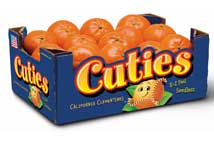
I’ve been eating a lot of Cuties.

Yep that’s right.  Some orange coalition out there successfully persuaded me to seek out a sack of clementines by brand name.

How on earth did that happen?  They’re frickin’ clementines!  A nice feat indeed.

I started thinking about what other commodity products have brand names, and I realize there are actually a bunch.

Here, let me remind you of a few -

So how do you take a commoditized product and make it a brand?  Here are a few things -

  • Have some form of consistency.  Cuties has this one down pat.  A week after I bought my sack of Cuties, I went to a farmers market and bought a bag of clementines. It was then that I learned — not all clementines are created equal.  Not only did I have malformed triangle shaped clementines, some of them had seeds in them.  Blasphemy!  Branding is about the expectation of consistency and a certain amount of quality.  Cuties are about as homogeneous as they come.
  • A story. You and I know the tagline.  “Diamonds are forever.“  Somehow, this holding company sold you a story whereby millions of fools each year hawk over some large chunk of change for a not nearly proportionate small chunk of non-rare carbon.   Or Kobe beef with the cows that are massaged and provided with classical music.
  • Loads and loads of visibility.  Gas stations have this one covered.  As do certain “brands” of fruits and vegetables in grocery stores.  When’s the last time you remember some other brand of bananas or oranges than Chiquita or Cuties at your local Safeway?  That’s distribution lockdown right there.
  • Be part of some collective.  Typically many of these products are part of a collective so that there’s more negotiating power and a marketing budget.  Vidalia Onions are offered as a loss leader in some supermarkets in exchange for muchos visibility.
  • Trademark protection + Regional lockdown.  Champagne?  Port?  Parma Ham?  These are all regional products that have name protection lockdown and a good story to make it worthwhile.  As well, the geographical restrictions serve to limit supply and keep prices at a premium.

And with that, it’s time to figure out what product I can commoditize. :)

Posted in Branding | Tagged | Leave a comment

On chewing gum and impulse purchases

I will fess up.

I’m  a gum addict and I buy gum in Costco case lot sizes.

But for most normal people, I suspect gum is a pretty impulse purchase.

Have you ever noticed how grocery or drugstores are laid out?   Notice that necessities (milk, eggs, meat, meds) are in the back of the store, but the bad-for-you but oh so tempting kinds of goods are all located near the checkout.  The truly evil stores (like Bristol Farms in Westfield Mall + any Frys Electronics stores) make you snake through aisles of junkfood and chocolates and chips and stuff before you’re given the privilege of parting with your money at the alter of the cashier.

There’s a reason.

Impulse purchasing.

Impulse purchases break from the typical logical/rational decision making process.  It taps into the concept of instant gratification where the decisions you make are emotionally driven.  Yah, it means you find yourself doing things and buying things you had no idea you were going to.  Right now, 66% of confectionary brand decisions are made in stores, so that’s one category that’s got impulse purchase behaviour down pat!

:)

Some interesting general facts about impulse purchase behaviour:

  • Young, unmarried adult households with higher incomes do 45% more unplanned buying.
  • Households led by an older person and those that have larger families do 31% to 65% less spontaneous purchasing.
  • There is 25% less unplanned buying among shoppers who mainly use newspaper ads for price information.
  • People who consider themselves very “fast and efficient” shoppers are far less likely to make impulse buys — 82% less than the average.
  • If the purpose of a shopping trip is “immediate needs or forgotten items,” the rate of buying in unplanned categories falls by 53%.
  • Unplanned purchasing goes up by 23% if the shopping trip itself is unplanned, but it goes down by 13% if it’s a major or weekly trip.
  • If a shopping trip includes stops at multiple stores, there is 9% less unplanned buying at the second or third store.
  • Unplanned purchasing goes up by 44% if the shopper goes to the store by car instead of on foot.

    (Excerpted from a Wharton study, Unplanned Category Purchase Incidence: Who Does It, How Often and Why“)

Impulse behaviour works in other scenarios too.  On Travel Brain, we leveraged impulse behaviour to build our travel content – all of our tips and reviews.  We got a contribution rate of 5-10% (versus the standard 1%) by asking users to come on and do something simple (like create a map of where they’ve been).  Once they did that, we asked them to share a tip or review of a place they just finished telling us they’d visited.  Our users agreed more readily because they were already there first doing something else.

So think about how you might tap into impulse behaviour into your product.  Last minute upsell?  Using some other necessity as a hook?  On that note, I think I’d like to buy a planned purchase cupcake.

Posted in Marketing, Psychology | Tagged | Leave a comment

On the concept of loss aversion

Losing something sucks ass.

In fact it sucks more than if you never had it to begin with.  It’s the concept of loss aversion.  Studies show you feel twice as much pain from loss than you do pleasure from  a gain.

Well that’s no fun.  How can you make the best of it?

For starters, you could design products with this consumer behaviour in mind. :) :) :)

Some example applications:

  • Airlines, shopping sites like Gilt do this amazingly well.  Want a ticket? You better buy it quick because even if it’s in your cart it could disappear if you don’t complete your transaction within minutes.  That countdown timer is pure evil.
  • When asking for charitable donations, instead of telling people how many goats you can buy with the donation, how about the # of people who won’t die because they’ve been fed?  The number of shelter animals that don’t get put down because you made a donation.  Hear that?  Make a donation. ;)
  • Networking or dating sites, where your messages and stats might get deleted after 30 days or x period of inactivity unless you pay to upgrade
  • Farmville (and all its permutations) where your crops die from neglect unless you check in on the crops.

Also, knowing this instinct:

In making decisions, consider whether you’re being caught up with sunk costs.  What you’ve invested in something so far should not influence whether you continue to do it.

Posted in Experiences, Happiness, My life lessons, Psychology | Tagged , | Leave a comment

On signalling (for something like dating)

So I just learned that my ex started seeing someone a few weeks after we ended a 10+ year relationship.

My feelings about this aside, it got me thinking about the game of dating.  And that’s because dating is very much about selling a product — it just so happens that the product is probably a pretty personal matter.  C’mon, it’s you. :)

Market economics for a matchup is all about supply and demand, and given that I’m not a dating advice columnist, I’ll leave the supply side out of this. :p

So how do you increase the demand for a product like yourself?

Differentiation
In a crowded market, standing out is pretty important critical.  In The Game by Neil Strauss (yes, I’ve read it, and no, not because of this :p), that’s the concept of peacocking.  What’s something surprising or unusual about you that breaks from the clutter?  Hopefully you’ve picked differentiating on something that’s actually in demand!

Perceived scarcity
It goes a bit hand in hand with the previous point, but if you’re not seen as a few-of-a-kind (meaning that you are not hyper-differentiated), then there’s no reason to pull the trigger.   Ok ok, so maybe standards might be lower for casual dating, but point being the more scarce you are, the better the odds. ;)   Ideally you’ve got a few things that’s the intersection of highly unusual and highly desirable.

Urgency
If you’re differentiated, and it’s clear you’re rare, it doesn’t matter a minute if  the perception is that you’ll be around and available forever.  Think about the psychological impact of an auction.  You often pay far more than you intended because if you wait, it’s gone.  So what can you do to give the impression that if they wait, you’re gone?

Emotional Connection
The most successful brands speak to you emotionally.  Think about the feelings that come to mind when you think of brands like Apple, Mini Cooper, Molson Canada’s I am Canadian campaign (it being crap beer aside :p).:

Shared experiences (ideally novel, thrilling, or dangerous) tends to help with creating closeness and establishing an emotional connection.  As does skipping fluff in conversation like the weather or your job and focusing more on things like the challenging times you’ve faced; events that shape who you are today.

Indifference (aka, not desperate)
Dating is a psychological game.  It feels calculating, but unfortunately, it’s true.  You’re a far more desirable brand if you create the impression that you care — just that little bit less than your potential counterpart.  Don’t go too far the other way though to be completely unavailable.  Studies have shown that a less attractive person who sends a positive signal (e.g. brief eye contact) will be approached far more frequently than someone who’s a 10 and sends no signals.

Brands devalue themselves when they engage in heavy, constant discounting.  Don’t be that brand.

Frequency of contact
Familiarity might bring complacency and potential boredom down the down the line, but if you’re an interesting person and there’s already physical attraction and an emotional connection, increasing the opportunity to be reminded of the person or just spending more time together having meaningful shared experiences will certainly increase the odds of engagement.  It’s why dating or emotional affairs happen so often in the workplace!  Long hours, close proximity, common bond = muchos kindling.

Be hot.
It’s true.  Packaging matters.  It doesn’t mean you have to be the 99.99% percentile to the world – just be that to the person (people) who matter.

Be Surprising
If you’re predictable, you’re less interesting.  That’s not to say be schizo.  Once you establish a connection, you stay more intriguing if there are little surprising or unexpected things about you.


Mind you, this is all purely academic as 1) I’m absolutely no dating expert, and 2) my very dear friends are more than satisfying my need for connection right now :) — meaning I have no intention of applying these points to anything!

And to these friends, thank you. :)

Posted in Branding, Marketing, My life lessons, Positioning | Tagged , , , | Leave a comment